Saturday, 13 June 2015

wildlife and nature in northern Peru


Not at all in the order of the trip, but I've wanted to see a sword-billed hummingbird for many years, so this has to be the first photo for this post!  My top target for the trip was actually a different hummingbird, the marvellous spatuletail, but as expected I did not get to see it - after all, this was not a birding trip, but primarily one focused on archaeological sites.  But I was very happy to see the sword-billed, and that it sat still for long enough to enable me to get a focused photo!

I did see a number of good new bird species, including the endemic Tumbes Tyrant, White-winged Guan, and Koepcke's Screech-Owl - the first two, with a number of other species, at the Chaparrí reserve.  This was a wonderfully remote place with rustic yet comfortable cabins in the middle of a low scrub forest (I slept so well!), great food and very comfortable hammocks hanging in the porches.  I would have liked to spend another day there, in a reserve which had more than just birds. We didn't see any of the wild spectacled bears, only those in the rescue and rehabilitation centre, but a fox was cheekily walking around near the kitchen.

We drove through the arid coastal desert and up into (and over) the Andes, much of which was also very arid with little vegetation except for cacti.  There was the odd hummingbird - and some tarantulas in their web-nests beside the road - and one just sitting on the side of the road.  Like many people I find these spiders both fascinating and repellent at the same time.  We briefly passed through cloud forest, and also just into the Amazonian region where the Gocta Falls were located. 'Discovered' less than a decade ago, these are amongst the highest falls in the world, and the walk towards them, up and down hills between coffee and sugar cane crops and finally through a small area of virgin rainforest, was hard but very enjoyable.  This picture to the left is a distant view from early on in the walk, but I was one of those who succeeded in reaching the base of the falls.

When we got there our guide took a look in the rubbish bin, and didn't seem very surprised to find an oppossum in there...


The other part of the trip was the chance to see the Raymillacta festival in Chachapoyas.  This has been going for some twenty years, with groups coming from quite some distance to take part.  Rather like a harvest festival really, many of the villages or associations showed off the produce from their area, either through their costumes or through samples of food and drink being carried through the streets.  Many were throwing or giving samples to the crowd and I brought home a little bag of organic coffee as well as having drunk various local corn and spirit drinks.  There was a great deal of music too, from brass bands to traditional pipes and drums, The only part I didn't like were the headdresses of two groups which included real toucan bills.

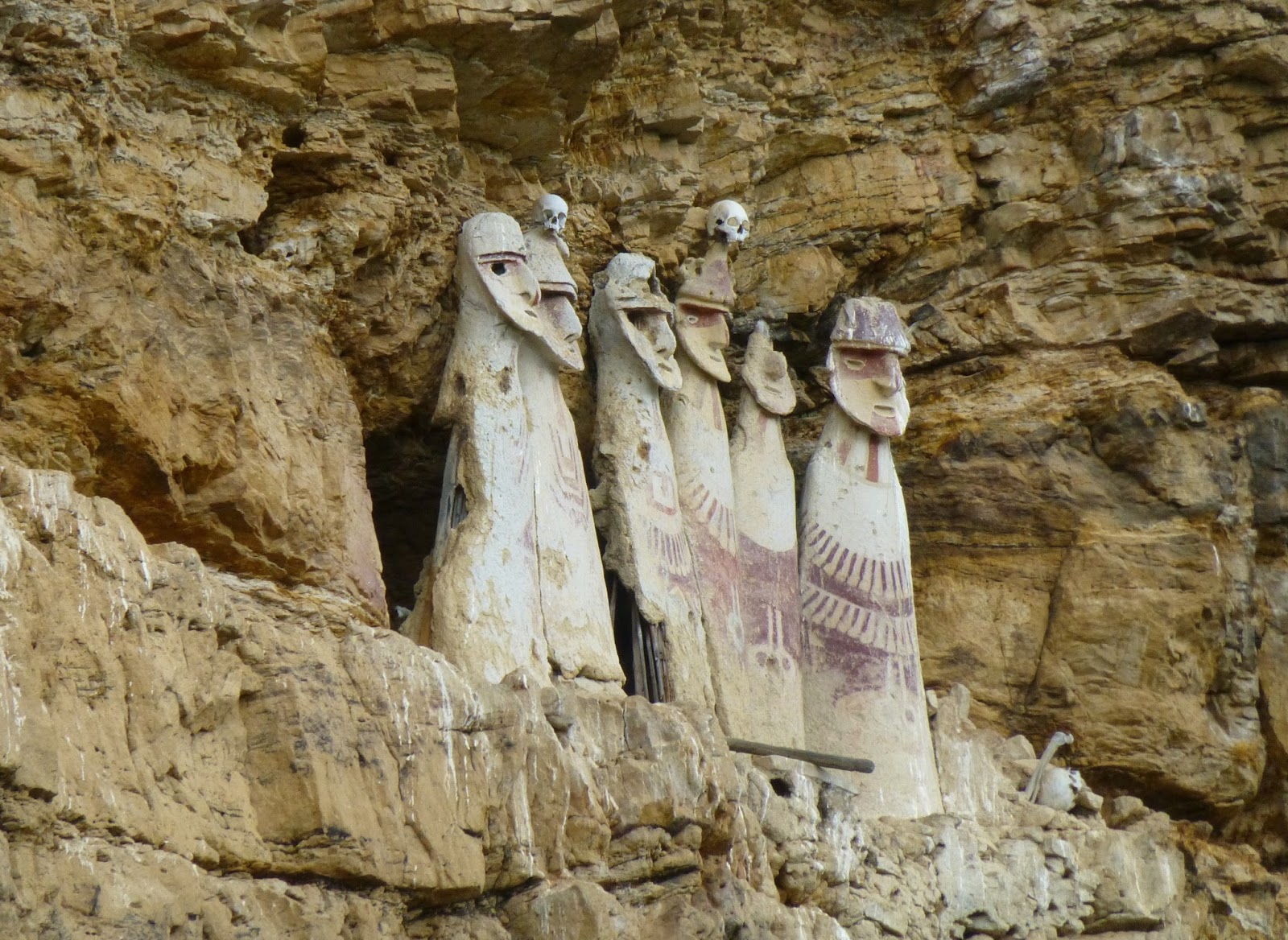
death in northern Peru part II


The Chachapoyas empire came later, dating from around 800 AD up to the time of the Incas, and was further inland so involved a long and scenic drive to get there from the coast.  At their funerary site of Karajía a number of sarcophagi sit on a high mountain ledge, their anthropomorphic mud and cane structures containing the bodies of the dead, some also with skulls atop their mud heads.  Believed to date from around 1200 AD, there are clear signs that there were originally more of these or similar structures on the cliff ledges, including a number of human bones on the path at the base of the cliff.  For me this was the best archaeological site of the trip.

At Revash we were able to get close-up views of other mountain-ledge tombs, constructed like large dolls houses but with human bones visible inside.


In the same area as Karajía we visited the large hilltop ruins of Kuélap.  Surrounded by a high (up to 20m high) and thick wall it is often referred to as a fortress but it was more likely just a fortified town, as it contains the ruins of over 400 buildings, mostly circular, that appear to have been living quarters or perhaps storerooms.  This was also a Chachapoyas site although a few later additions show that it was fnally taken over tby the Incas.  Perhaps they were responsible for the skeletons unearthed there recently, more than 120 having been thrown into a pit at the site.


A little further on, just outside of the town of Leymebamba, was another great museum.  It covers the history of the area but the clear highlight is a collection of some 200 mummies, found on rock ledges above the Lake of the Condors.  It seems that nothing much is known about them except that they date from the late Inca period.

Amongst all these reminders of death, the twelve of us on the tour were dropping (ill, not dead!) like flies.  Thankfully I only went down with a cold, although the mild temperature that signalled its arrival made a 2km uphill walk, at 2600m, one of the most difficult I have ever done.  Others also got coughs and colds, fevers, dizzy spells, headaches from the altitude and the twisting mountain roads, and a vomiting and diarrhoea bug laid some low.  Worst of all though came from a vicious dog that bit two of the group on the walk up to Revash.  In one case the bite went through skin and flesh and into the muscle, and the poor guy needed anti-rabies injections once we got back to Lima.

death in northern Peru part I

The Incas are so well known that little attention is paid outside of Peru to the various other civilisations that came before them, such as the Moche, the Chimu and the Chachapoya.  But it was the remnants of these earlier civilisations that drew me this time, so I signed up to a two-week Wild Frontiers tour of northern Peru.

We met up in Lima and started with a visit to the Larco Museum with its truly amazing collection of pre-Columbian pottery, jewellery and other relics.  A place that will be well worth a second visit when I next have a work assignment in Peru.

Then we flew north to Trujillo.  The better-known site here is the UNESCO World Heritage listed Chan Chan, with the remains of this great Chimu city covering nearly 30 square kilometres, but I much preferred the Pyramids of the Sun and the Moon from the earlier Moche period.  The excavations under way here have recently revealed more than 6,000 square metres of murals and reliefs on the mud walls being uncovered within the Pyramid of the Moon. many in very good condition.  The lower wall here, showing the 'decapitator' god, dates from around 300 AD.

After some time out to enjoy the natural environment (separate post to follow!), we headed further north to the site of Huaca Rajada, or Sipán, where the burial sites of a number of Moche warrior-priests were recently uncovered.  A visit to the archaeological site put eveything into context but another amazing museum showed the remains and the incredible collection of jewellery and other accoutrements with which these important people were buried, including the skeletons of the guards who were buried alongside them, with their feet chopped off to ensure that they never run away from the job.  Like most pre-Columbian sites in the region, the Huaca (pyramid) had been looted, but in this instance the looters had not found two very important tombs so the archaeologists were able to recover the contents in their entirety and display them in this fabulous museum.

Nearly as impressive were the burrowing owls that stood around the site.  The Moche venerated them (there are examples of these owls in pottery form).  I was told that this came from the fact that they move in all three worlds - burrowing into the underworld where the dead go, walking around on the earth with the living, and flying up (at least part way!) to the heavens where the gods live - but as they stood around staring at us with their unblinking yellow eyes it felt to me as though they were guarding the tombs, or even that they were the reincarnated spirits of the Moche rulers, and I wondered if their status came simply from this unnerving presence.


Wednesday, 20 May 2015

eighth wonder of the world?


I'm sure you all know that work is in progress to expand the Panama Canal so that bigger ships can pass through.  The project is already forecast to end 18 months late, and the cost has gone way over budget, but nevertheless the project is generally seen within Panama as a wonderful thing to be very proud of.

Last weekend the Panama Canal Expansion Company held an open day at the nearly completed Cocolí lock so that people could go and see the expansion project for themselves - to actually walk about inside one of the new lock chambers and look at the new lock gates - before they start to let the water in.  To get a view that will never again be possible.

Some 45,000 of us queued for hours in the pouring rain to get in, and amazingly the atmosphere remained upbeat despite the rain, even amongst the many Panamanians who came totally unprepared for rain (it rains every day guys, from May to December, haven't you learnt that yet?).  Not only did they allow us in, but they did not even charge any money for the privilege, despite having provided buses to drive us down into the lock, guides to explain what was what, display boards explaining the engineering, portaloos galore, and even free bottles of drinking water and little Panamanian flags to wave around.  & there was a lot of flag-waving as the people posed for photos in this engineering marvel.

I didn't take in that much of the engineering, except to note that the concrete for the first set of lock gates alone would be enough to pave a two-lane highway from one end of the country to the other.  Mostly it was just about looking up and being awed by the sheer scale of the thing.  This is how big those lock walls are:

Tuesday, 14 April 2015

crossing cultures

In my travels I like to visit places where the culture is not too corrupted by foreign influences.  But on the other hand I do enjoy that strange mixing of cultures that I sometimes find myself in.

I Bolivia, I sat one afternoon in Café London on the shore of Lake Titicaca, drinking a cappuccino, trying to read the next chapter of the Koran (prompted by the growth of IS and its affiliates I thought it important to know something of what drives them), Bolivian radio playing James Brown's "Get On Up (Like a Sex Machine)"... I looked up when I heard a ringing sound only to see an Aymara woman, in her traditional dress, walk past pushing a mobile ice cream trolley.  An equally strange combination to me was this seemingly middle class house and car, with four llamas in the garden:


At the same time I very much enjoyed my experience in a cool underground bar in La Paz, when an Aymara woman joined us.  She accepted a glass of whatever strange brew we were drinking, but poured a small drop onto the floor - for Pachamama (mother earth) - before drinking herself, then proceeded to ask me about typical society in the UK, seemingly with genuine interest.  A magical evening

Friday, 3 April 2015

in the Bolivian altiplano


I had a few opportunities to visit the Bolivian altiplano ('high plains').  Firstly as part of work when I went to review a youth livelihood project down in the south of the country.  This was way up at some 4,300m and took me past lagoons with Andean geese, Giant Coots and both Chilean and Andean Flamingos, as well as a hilly region full of cacti.  I usually avoid writing about work here, but will just mention that part of the livelihood project involved llama rearing; the llamas had just been delivered to the village, and at the time of my visit the vet was there giving a practical demonstration of how to castrate the males not needed for breeding (castrated males produce more meat) - very interesting to see but I did have to sit down with my head low ("to write some notes") once the blood started flowing.

Back in the northern part of the country, a colleague kindly took me out to the Tiwanaku ruins. These pre-date the various ruins from the Inca culture, and not that much is left of them, but there is an impressive sunken courtyard, probably used for ceremonial purposes, with carved stone head all around the walls. The museum is interesting too, particularly for the skulls, made narrow and pointy by the practice of binding the heads of babies to planks of wood. Apparently a long pointy shaped head was a symbol of great intellect.

After the work was finished I took a bus out to Lake Titicaca, for a couple of nights in the lakeside town of Copacabana and a couple of nights in the village of Yumani on an island (Isla del Sol) in the lake.  Isla del Sol is considered by the Aymara and Quechua peoples of Bolivia and Peru to be the birthplace of the sun and of the first Inca people, so has a number of sacred rocks, and interesting ruins such as these:


The island is also a great place for hiking although with a range from 3,800 to 4,100m above sea level it is hard going.  I puffed and panted a lot, and burnt my face in the strong sun as well as as needing six layers of clothing to stay warm when the sun went in.  It was certainly the right decision to pack my thermals!

Apart from the cold, the other shock was the prices.  $5 a night for a single en-suite room with sporadic hot water and wifi!!  Plus the four-hour bus trip there cost only $3, as did the four-hour boat trip from Copacabana to the south of Isla del Sol.  I changed $300 to be sure I had enough for five days and spent only $125!  & some things don't really have a price anyway - this is the view of the sun setting on Mount Illampu, taken from my $7 a night accommodation on Isla del Sol:


Friday, 20 March 2015

4km above sea level

La Paz airport is so high that there are oxygen tanks available for visitors who cannot cope with the altitude, and my office here told us not to attempt the 10 minute walk there until we'd spent two days in the hotel acclimatising.  Thankfully I did not suffer at all, but was not too unhappy to be confined to the hotel, looking out of the windows at the ever-changing play of light, shade and wispy clouds on the mountains surrounding the city.


The city is totally unlike any I have seen before - above is a view from one of the cable cars through the city.  La Paz itself has a population of 1.8 million, but above it, high along the steep sides of the mountains and on the high, flat altiplano, is another city, El Alto, of around another million people.  Parts of La Paz are really quite developed, with middle class citizens sipping cappuccinos in trendy cafes, but El Alto is where the poor people live, where apparently 90% of the factories are illegal - not registered with the authorities, not paying any taxes, making counterfeit products, etc.  It is dangerous to visit although has beautiful views of the surrounding snow-capped mountains, and is now (since late last year) connected to the rest of the city by a cheap and efficient cable car system.

I'd arranged a tour there with a group (the only way of going there in reasonable safety but it is still recommended not to carry anything with you and not to wear any jewellery), but it didn't materialise, so I set off instead into the centre of La Paz by myself.  I took one of the other cable car lines, then walked, then finally jumped on a 'trufi' (a cleaner, more modern equivalent to Kenyan matatus) into the centre.  At least missing the tour gave me a chance to visit the Ethnographic Museum before its midday closure, a really good museum with an amazing display of masks from different parts of the country.  Maybe one day I can get here at the right time to see one of the festivals, or even the Oruro carnival.

Then I wandered around the most touristy area, a few streets selling artisanal products, mostly clothes made from alpaca wool, as well as 'Street of Witches', where some of the little shops have a dried llama foetus or two hanging outside, to ward off evil.

Also in this area is the Coca Museum.  The coca plant plays a huge role in the history and culture of the country, used in sacred rituals for thousands of years, banned by the Catholic Church in colonial times as 'diabolical', re-legalised when the Spanish authorities realised that the miners needed it to enable them to put in long hours in the mines, banned again under pressure from the UN and US, and now legal again, as part of the moves by current president Evo Morales to recognise and celebrate indigenous culture.

Cocaine is illegal (and there are strict controls over the various chemicals needed to manufacture it), but the coca leaf, and all kinds of coca products, are everywhere.  We are encouraged to drink coca tea to help alleviate altitude problems, and I've also had coca sweets, coca beer and coca liqueur during my one week in the country.

The process for turning a harmless leaf into a potentially deadly drug, cocaine, was discovered in the West after the Bolivians had been happily using the leaf for thousands of years, and currently the 5% of the world's population who live in the US consume 50% of the world's cocaine (according to displays in the coca museum).  Perhaps, instead of trying to get Andean countries to wipe out a plant that holds such an important place in their cultures, the US could look at the conditions within their own country that lead people to make, sell and consume the illegal drug.  It seems that the only downside of coca within Bolivia is the deforestation to provide more land for its cultivation.  Whilst I'm sure it exists, I have so far seen no evidence of cocaine, nor of drug addicts, during my time in La Paz.

After a lunch of fairly tasty llama steak (with coca tea, of course!), I joined up with a tour group for a very strange experience - cholitas wrestling.  High up in El Alto is a small sports arena, where every Sunday evening there is wrestling.  Not like Senegalese wrestling where people fight to win, but rather the American version where everything is choreographed.  Still, it was a spectacle.  It started with men in typical wrestling attire, but then moved onto Aymara women in thier traditional outfits (although they removed their hats once in the ring).  It was crazy stuff, with the 'cholitas' throwing eachother around the ring, and out of the ring, and hitting eachother over the head with trays and wooden crates, one of the referees occasionally joining in the 'fight', the crowd cheering, booing, throwing popcorn and coca cola at the contestants... and yes, if you wondered, coca cola does still contain coca leaf extract, being one of a number of multi-national organisations that are exempt from the international ban on the leaf.